
November 13, 2025
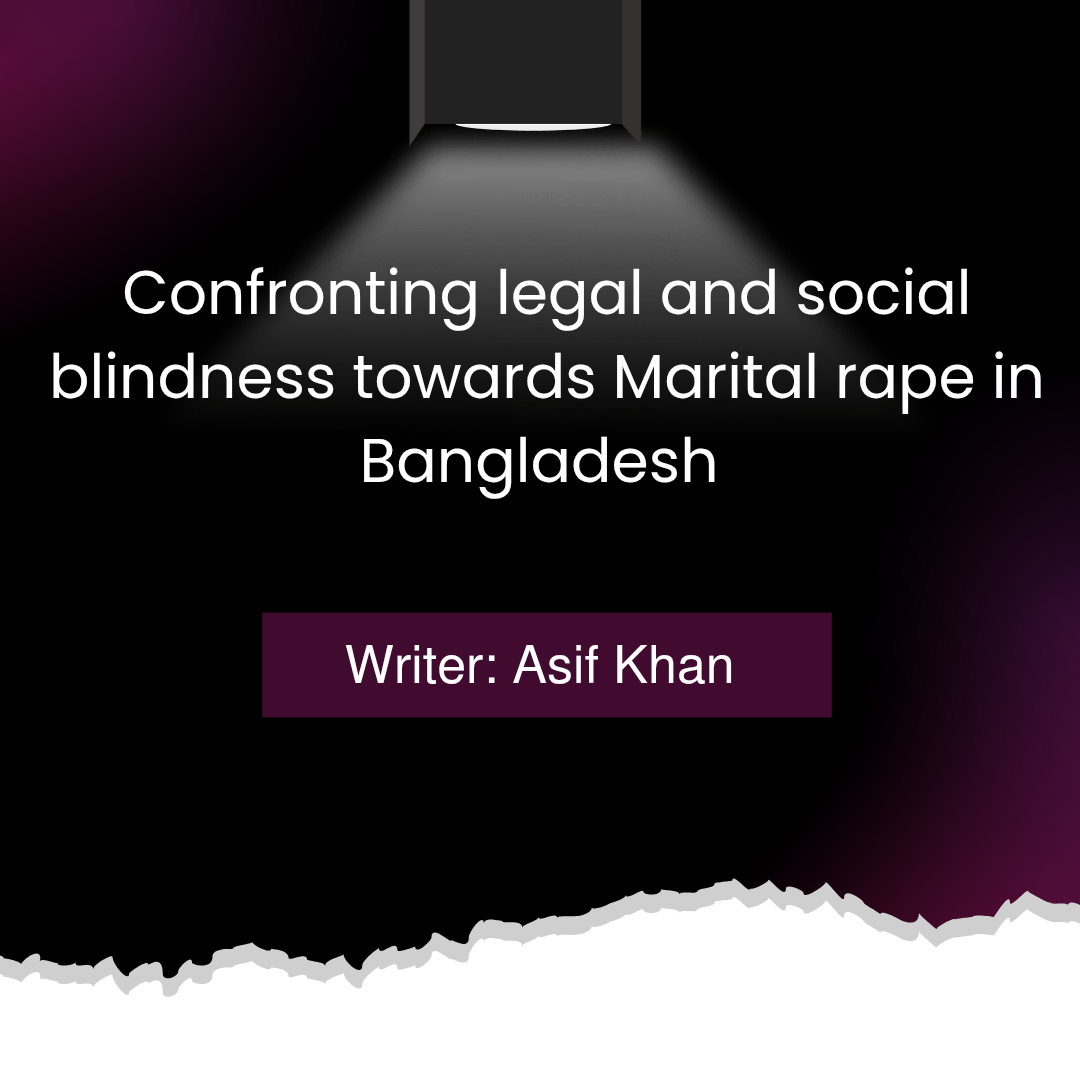
𝐂𝐨𝐧𝐟𝐫𝐨𝐧𝐭𝐢𝐧𝐠 𝐥𝐞𝐠𝐚𝐥 𝐚𝐧𝐝 𝐬𝐨𝐜𝐢𝐚𝐥 𝐛𝐥𝐢𝐧𝐝𝐧𝐞𝐬𝐬 𝐭𝐨𝐰𝐚𝐫𝐝𝐬 𝐌𝐚𝐫𝐢𝐭𝐚𝐥 𝐫𝐚𝐩𝐞 𝐢𝐧 𝐁𝐚𝐧𝐠𝐥𝐚𝐝𝐞𝐬𝐡
𝐂𝐨𝐧𝐟𝐫𝐨𝐧𝐭𝐢𝐧𝐠 𝐥𝐞𝐠𝐚𝐥 𝐚𝐧𝐝 𝐬𝐨𝐜𝐢𝐚𝐥 𝐛𝐥𝐢𝐧𝐝𝐧𝐞𝐬𝐬 𝐭𝐨𝐰𝐚𝐫𝐝𝐬 𝐌𝐚𝐫𝐢𝐭𝐚𝐥 𝐫𝐚𝐩𝐞 𝐢𝐧 𝐁𝐚𝐧𝐠𝐥𝐚𝐝𝐞𝐬𝐡
Justifying marital rape is used as one of the tools of patriarchy to reproduce the dominance against women. We tend to forget rape is an abuse of power regardless of the relationship between the offender and victim. Rape is also often framed as illness which is highly problematic. It implies that rape is something separated from everyday relationships and family settings. Rape is also often framed as illness which is highly problematic. It reflects rape is exclusive of everyday relationships and family setting. But in reality , a rapist can be someone close to us like family members, relatives, or friends. A recent statistics from BRAC shows, 77% violence against women is perpetrated by family members (Bhowmick, 2019). Another study shows that 68% of occurrences of violence against children and women go unreported (Suraiya, 2018). Women are collectively excluded from political and economic positions of power in this patriarchal structure.
Marriage should never be a free pass to violate someone's body. But in Bangladesh, marriage is perceived by many men as a legally and socially accepted gateway to exert control over women’s sexual autonomy. Traditional gender roles associated with marriage contribute here where a wife is expected to meet her husband's physical desire irrespective of the reasonability. Being married to someone doesn’t mean they have a right to have sex without consent. Sex without consent is rape, no matter how positive the coonotations associated with the relationship may be. It is as simple as that.
Many patriarchal agents even try to bound rape within constructed moral boundary excluding the importance of consent in marital sphere. According to Douglas (1966), something considered as dirty signifies a violation of social order that reinforces the purity, validity, and naturalness of whatever falls within the accepted boundaries. In this case, extramarital sex is considered as dirty, but non consensual sex within marriage is not as it stays within the realm of sanctioned boundary. These people justifying marital rape in the name of maintaining social order, harmony, and cohesion.
Did we forget the case of Nurnahar, a 14 years old girl who died in 2020 due to excessive genital bleeding? The bleeding started on the very first day of her wedding night. But the cruel husband continued having sexual intercourse day after day regardless of her deteriorating condition. I am getting goosebumps while writing about this incident here now. Despite having a clear evidence of it, our law wouldn’t consider this as rape because according to section 376 of the penal code, marital rape is only punishable if the wife is under twelve years old, and the punishment would be maximum of two years imprisonment, or even just a fine. This law carries a colonial legacy and this law was created based on victorian patriarchal values. Wives were treated as the husband’s property under this value system. Even, the Child Marriage Restraint Act, 2017 legalized child marriage under special circumstances but this special circumstances haven’t been defined clearly. So, In Bangladesh, an offender can forcefully penetrate girl children without her consent legally as long as they are married. According to Joyee (2020), In Bangladesh marriage is a license to rape children and it’s easier to obtain it than getting a driving license. Just like Nusrat, there are a vast number of married women who are facing sexual violence silently everyday regardless of the class,religion, or cast. 27 % Bangladeshi married women have gone through forced sexual intercourse by their husband (Report on Violence Against Women Survey, 2015). If we just talk to some gynaecologist, we can see how much brutality is embedded in it.
Women also play a role as a patriarchal agent to reinforce this issue. In a patriarchal society, women herself feel that they lose their bodily autonomy after marriage. Whenever any married women share their experience with female relative, they suggest her to find the spark in the system and convince her to adjust in the established system. We can also see it Nusrat case too where her mother in law tried to protect the perpetrator by building a narrative of ghost possession which caused excessive genital bleeding. It implies with a common saying, “Delulu is Solulu”, which means embracing delusion to cope with problems. Regardless of gender, the cumulative effort of patriarchal agents make sure to silent the voices of victim and reinforcing marital rape as a normal thing. According to Tahsin (2024), “Unfortunately, the people of the same mindset are in drafting, refining, interpreting, ratifying, and implementing our laws.”
Despite its legally backed ferocious brutality, recent BRAC survey showed that only 4% of the people considered marital rape as a form of violence (Bhowmick, 2019). In this year, 2025, last half of april, when the discussion of new domestic violence law draft that recognize marital rape as sexual abuse came into place, many people started criticizing it destructively. Some political leader changed the definition of rape by associating it with extramarital affair. I discussed the mechanism behind it in the third paragraph. Many people just seems like can’t process how can the question of rape arise in the prestigious institution like marriage. Many of them compared marital rape with wife’s stealing money. Many people saw this reformation as propaganda and a large group of people are worried about the probable misuse of this reform.
Observing these rhetorics, at first, I just wondered how they would respond if they were in the place of Nusrat's parents. Many people who are questioning the need for reformed marital law suggested the victim to get a divorce with an abusive husband. What about the victim’s trauma, genital tears, and the painful night rapist husband gave to her? Doesn’t she deserve a legal ground where she can opt for justice? Criminalizing marital rape isn’t about invading personal space, it’s about recognizing that rape is rape regardless of the relationship. Coming to misusing this law, do they demand to abolish the rape law just because there are so many false accusation revolving around it? The answer most probably would be no. The same goes for marital rape law also. We should raise demand for a better justice system instead where laws will be implemented fairly. There are qualified lawyers you can take help from if you are falsely accused. There are qualified doctors to investigate the sexual offence through forensic analysis, case assessment, and interpretation. The alleged victim will have to prove the claim through conclusive evidence. The whole legal system's job is to evaluate whether the accusation was true or not through rigorous procedure.
Justifying marital rape is rooted in patriarchal structure. Legal intervention is important but to prevent this issue, we have to keep the conversations alive and keep questioning the discriminatory, destructive value patriarchy holds to eliminate it from the roots.
Reference:
Bhowmick, R. (2019). Violence against women: Is physical abuse the only form?-The Good Feed. The Good Feed. https://blog.brac.net/violence-against-women-is-physical-abuse-the-only-form/
Douglas, M. (1969). Purity and Danger: An analysis of concept of pollution and taboo.
Joyee, A. J. (2020). The horrors of the marital license to rape. The Daily Star. https://www.thedailystar.net/opinion/news/the-horrors-the-marital-license-rape-1985837
Tahsin, A. (2024, March 18). Is “Delulu The Solulu” to Marital Rape in Bangladesh? Swayong. https://www.swayong.org/post/is-delulu-the-solulu-to-marital-rape-in-bangladesh
Suraiya, S. (2018). 77% of violence against women is perpetrated by family members - The Good Feed. The Good Feed. https://blog.brac.net/77-of-violence-against-women-is-perpetrated-by-family-members
Report on Violence Against Women Survey. (2015). UNFPA-Bangladesh. https://bangladesh.unfpa.org/en/publications/report-violence-against-women-vaw-survey-2015
Related News

November 13, 2025
November 12, 2025
November 04, 2025
October 22, 2025
October 27, 2025
June 02, 2026
June 02, 2026

October 26, 2025
June 02, 2026

October 26, 2025
October 26, 2025